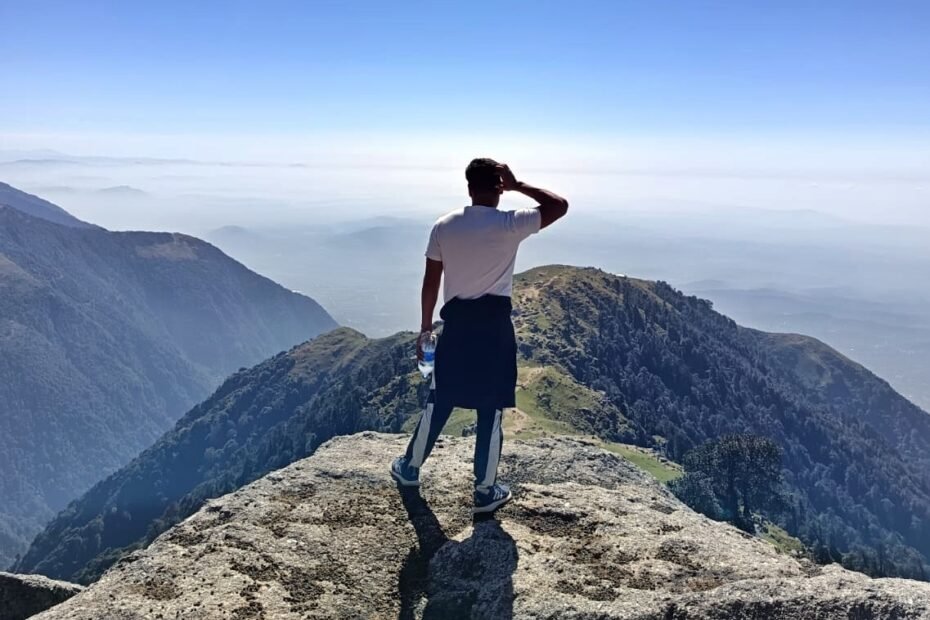
No, I am not talking about leaving your job or selling your property to live on the streets.
Let me explain where I am coming from.
I acknowledge that preparation for the future is one of the most important human traits. We can imagine scenarios and prepare for them, whether they actually happen later or not. We never know whether we’ll wake up tomorrow or not. But that is the topic for another day. My point is that we prepare for the future mainly to ensure some kind of safety (physical, emotional, financial, etc).
For most of its time, human civilization has lived under constant fear in the forests. We have recently reached the top of the food chain in an artificial way, but for most of the time, we were the prey rather than the predators.
So, imagining the threats and our possible responses to them was a major part of our daily life.
This predator-prey interaction shaped our perception, emotions, learning, attention, reasoning, and social behaviour to a large extent.
The fight, flight, and freeze response comes from the mental networks that we have created just for survival optimization. This paper explains the human fear perfectly.

However, the brain cannot perfectly distinguish between real and imagined threats. Imagining the future threats activates many of the same emotional systems that are involved in actual danger.
So, if you have an interview tomorrow, your brain is designed to worry about it based on the importance you give to it. You have something attached to the interview. You want to achieve something or fear losing something from it. Sitting in the interview and being nervous is perfectly ok. But, imagining the questions and you not being able to answer or stuttering is the ancient brain networks trying to prepare for the worst.
The returns from mental preparation
For almost all my life, I have been a very serious overthinker. I have thought about the weird things, and in even weirder ways. I can’t even admit some things that I used to imagine as a child.
It felt good. It felt like something was happening in your empty life. Preparing for an exam was boring and effortful. But imagining you as the topper of the class was always easy and comfortable.
If I talk about the variety of my overthinking, it is always the negative one. The one with the worst-case scenarios. The one where I imagine myself to be humiliated, beaten, failed, or even killed. This gives rise to hormones like adrenaline and cortisol.
And, we can say, for a second, that thoughts are nothing. They are just clouds arising on their own in the mental atmosphere. We can’t say that about these emotions. They are real. They are literal chemicals in our bloodstream and can trigger various other physical responses like anxiety and panic attacks.

You get relieved after a minute or less, realizing that something was just a thought and had no existence in reality. This gives relief.
You can’t say that about an emotion. Whenever you try to fix your anxiety with good thoughts, it never happens because the body will take its time to clear out those hormones, and you will have to wait for some time till you feel normal again.
Logically, there are no returns from any mental preparation because nothing happens in the real world. Again, we can’t stop thinking, and we should not try that either. But the acknowledgement is the first step.
The secret joy of worrying
When you worry, you are secretly enjoying it. You may not believe but from an evolutionary perspective, our ancestors benefited from anticipating danger. Thinking ahead helped them avoid predators and prepare for harsh weather and various other things.
As a result, the brain learned to treat mental preparation as something valuable. I believe it would have helped them. That is the reason we are here. They survived because of these habits and were able to save their offspring. So, I am sure the brain has attached some sort of reward to it.
I have heard people say “worrying helps me prepare” or “If I stop worrying, I’ll be caught off guard”.
For a hunter-gatherer, being caught off guard means instant knockout. I accept that.
But do we have to fear those things in our concrete apartments?
I believe not, unless you are living alone in some tent surrounded by bears.
The issue

Our brain was never evolved to make us happy. Its main purpose was to keep us alive. Missing a predator hiding in the grass could mean you didn’t survive to see another day.
As a result, the brain evolved to give greater attention and emotional weight to potential threats than to upcoming rewards.
Psychologists call this tendency the negativity bias. It is basically the observation that negative events and emotions have a greater impact on our thoughts, feelings, and behaviour. We are naturally inclined towards thinking about the negative things.
It isn’t necessarily pessimism but an ancient survival strategy. The brain treats possible dangers as problems that require immediate attention.
Now, the ancient dangers are gone.
We are not living in the jungles.
Still, we are practicing the same thought process. We know very well that what we think has no possibility to be true all the times. Still, we do it.
We do it firstly because the time that our ancestors have spent in the jungle is far more than what we have lived in the “safe world”. So, the training that we have got over those centuries will need time to be revoked.
Secondly, we are never taught to treat thoughts just as thoughts. We were never taught to pay attention to our mental processes and not to give weight to all of them.
What sets the human brain apart from most other animals is our highly developed prefrontal cortex. It acts as the brain’s executive control center. Structures like the amygdala and hypothalamus are parts of the brainstem that evolved long before humans. Their job was simply to make sure I was safe.
But, unlike most people think, having an active pre-frontal cortex doesn’t necessarily mean you are more human and have better control over the ancient parts of the brain.
A simplified overthinking process looks like this.
A simplified sequence looks like this:
- The amygdala detects a possible threat.
- The body becomes alert.
- The prefrontal cortex starts analyzing:
- “What if this happens?”
- “How can I prevent it?”
- “Did I miss something?”
- If uncertainty remains, the amygdala stays active.
- The prefrontal cortex continues searching for certainty.
- The cycle repeats.
The solution

I am not a psychologist nor have any medical qualifications. I just get knowledge from the internet and try to tie knots here and there.
What I believe can be the solution is a little spiritual. Looking at your thoughts from a distance is possible. You can learn to identify a thought as soon as it arises. If not, you can notice it when it starts to trigger some emotion in the body. As you identify with it, you are detached from it.
If you hate the spiritual language, the word “detached” will seem preachy. It sounds preachy to me, at least.
But there is some logic to it. You can truly think of one thing at a time. So, as you become aware of the thought, the mental space is occupied by the belief that you have acknowledged the thought. The real thought itself has left your mental space already.
This is the practice also taught in Metacognitive therapy and known as detached mindfulness. I found it great and am trying to tell as many people as possible.
I know your next question is How do I make decisions then?
Let the decisions come from themselves. Keep expanding your knowledge, and your decisions will be way better compared to what you used to take through prolonged chewing and vomiting of thoughts.
Thanks for being here.