
Orchids is the largest family of plants after the Asteraceae with around 28,000 species.
But, unlike what most people think, around 70% grow on trees while others prefer the land.
The reason is simple.
Growing on trees give orchids a survival advantage, not because they depend on a tree for food or water. Orchids are epiphytes, not parasite. An epiphytic orchid uses the tree only as a physical support. By living high above the forest floor, they gain better access to sunlight, experience less competition from other plans, and recieve a btter air circulation. Also, they get good moisture from rain, mist, and humidity while residing on a tree.
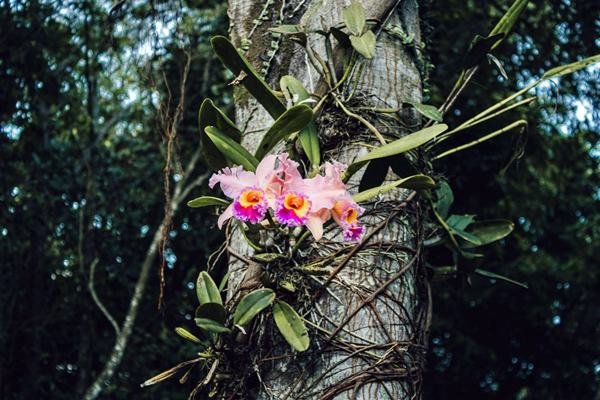
Compare it to living in a high-rise apartment instead of crowded street. The forest floor is crowded with ferns, grasses, shrubs, fungi, etc. On branches, there is no competition like that.
Higher branches receive more rainfall and humidity
The first important thing for any plant is water/humidity. Tropical forests experience frequent rainfall, high humidity, morning dew, and mist, all of which provide water for epiphytic orchids. Because these plants are exposed to the open air, their roots can quickly absorb moisture whenever it becomes available.
Unlike the roots of most plants, the roots of orchid plant are covered by a spongy layer called velamen. This acts as a natural sponge, rapidly soaking up raindwater, dew, and water vapor from humid air.
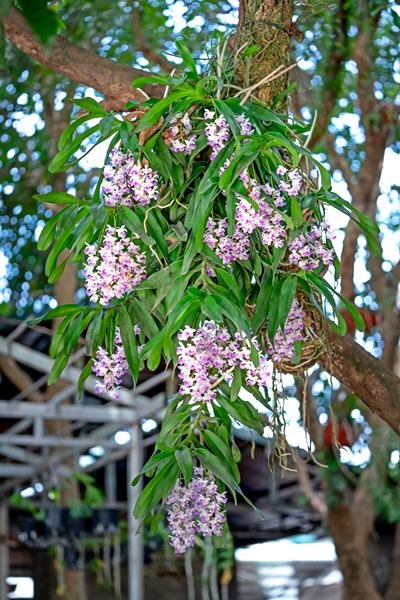
Cracks in the bark, patches of moss, and decaying leaves trap rainwater and provide tiny amounts as the organic matter decomposes. However, orchids do not draw nutrients from the tree itself unlike some parasite plants like Mistletoe, Dodder, or Rafflesia.
Another advantage of growing on a tree is the availability of good airflow. After rain, the roots dry relatively quickly, reducing the risk of rot and fungal diseases. This balance of frequent moisture and rapid drying is ideal for most epiphytic orchids. In contrast, constantly waterlogged roots would deprive them of oxygen and eventually damage the plant.
Higher branches receive more sunlight
Sunlight is one of the biggest reasons many orchids grow on trees. In tropical rainforests or even in normal forests, the dense canopy formed by tall trees blocks most of the sunlight from reaching the forest floor.
Studies have shown that only a small fraction of the available sunlight (often less than 5%) penetrates through the canopy to the ground in mature rainforests.
By growing tree trunks and branches, orchids position themselves much closer to the canopy where the sunlight is far more abundant. This gives energy to the plant and ability to do photosynthesis.
In simple words, for orchids, growing on trees in an energy- efficient solution. Instead of competing without countless plants on the forest floor or investing precious resources to grow taller, they take advantages of the trees which have already reached a certain height.
They avoid many ground-dwelling herbivores
Growing several meters above the ground helps orchids easily avoid grazing mammals, slugs, snails, and other insects that feed near the forest floor. While canopy insects can also eat orchids, the risk from some ground herbivores is reduced heavily.
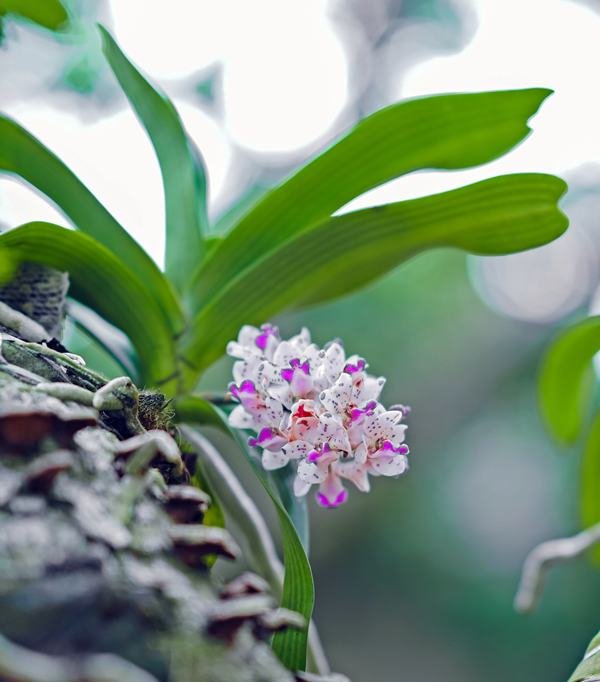
All in all, orchids just stay on the top seeing the predators on the bottom from a distance and thanking their ancestors for choosing that lifestyle.
If growing on trees has so many advantages, why don’t all plants do it?
See, evolution doesn’t create perfect organisms. It just favors organisms that are well adapted to their particular environment. Becoming an epiphyte requires a set of specialized adaptations, and most other plants simply never evolved them. So, there are some evolutionary trade-offs that the orchids had to go through in order to become epiphytes in the first place.
Over millions of years, some orchid ancestors gradually evolved traits that made this lifestyle possible. With the help of velamen and the ability to anchor tightly to the bark, these plants become ideal candidates to grow on the trees.
Another remarkable adaptation is the reproduction of orchids. Orchids produce among the smallest seeds (almost microscopic) in the plant kingdom. They are easily carried by the wind. So, the chances of them landing on another tree are very high. And, if the conditions are well met, they will germinate.
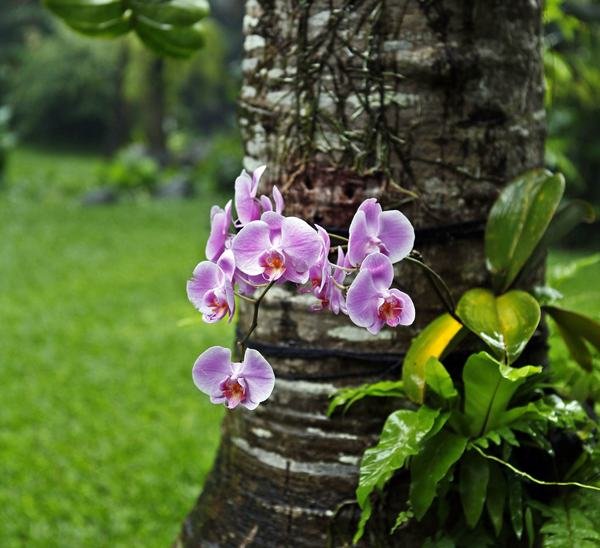
Scientists estimate that the epiphytic lifestyle evolved independently multiple times within the orchid family. This is a strong indication that growing on trees offered significant evolutionary advantages in tropical forests. Today, around 70% of all orchid species are epiphytes, making orchids the most diverse group of epiphytic flowering plants on Earth.
Conclusion
Orchids are beautiful and smart at the same time. Their growth on any tree is harmless to the it. Unlike most plants, orchids seeds contain no endosperm (food reserves). So, to germinate they must for a partnership with soild fungi called mycorrhizal fungi. I admire their ability to grow in very adverse circumstance. Trees are like friends to them helping them grow and thrive even in competitive environments. They grow amazing flowers and all we should do is admire these highly interesting flowering plants whenever see them.